
It would be criminal to leave Kent’s county town without talking about the ferocious battle that occurred here in the Seventeenth Century, or mentioning at least one of the wrong’uns who’ve spent time in the local clink.

Large-scale urban warfare wasn’t common in the English Civil War, but on June 1st, 1648 around six thousand combatants turned the narrow streets of Maidstone into a labyrinthine, smoke-wreathed abattoir.

Outnumbered two to one, the local Royalists retreated into the town, hoping barricades, strongpoints, and cunningly-sited cannons would help even the odds. Led by veteran commander Thomas Fairfax, the men of the New Model Army were forced to fight hard for every building, street, and square. When resistance eventually ceased at around midnight, approximately four hundred corpses littered the rain-lashed, lightning-illuminated thoroughfares of the town. Inhabitants marked the mayhem by renaming the road that had seen the heaviest fighting ‘Havock Lane’.
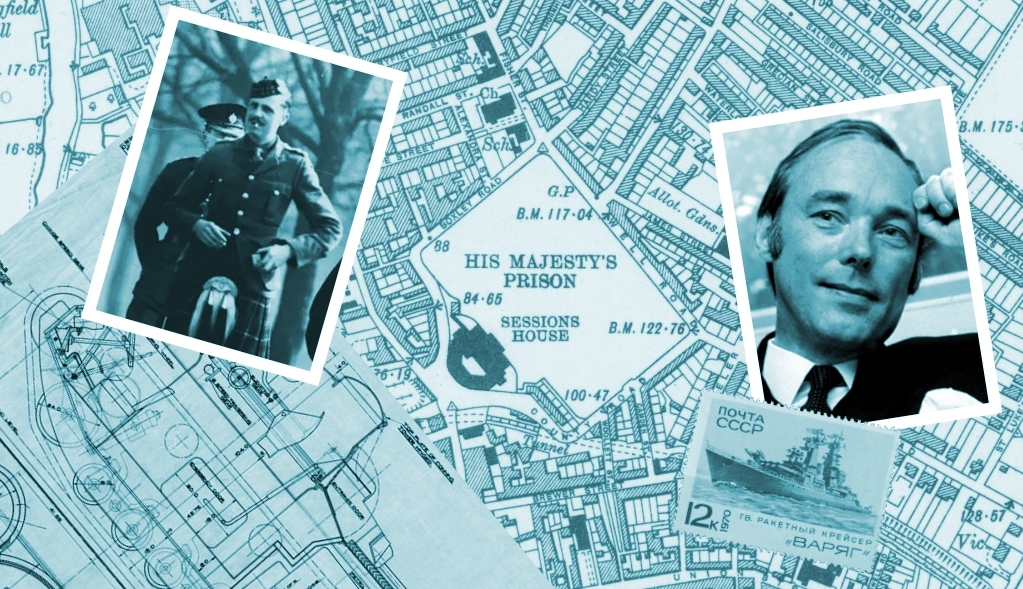
Across the road from the Hare & Hounds, the hostelry featured in part 1, sits HM Prison Maidstone, an establishment that has housed a number of notable lawbreakers. London gangster Reggie Kray and Easter Rising veteran Éamon de Valera you’ve probably heard of. Norman Baillie-Stewart and John Vassall may be unfamiliar.

A disenchanted officer in the Seaforth Highlanders, Baillie-Stewart tried his hand at espionage in the early Thirties. As one of the more substantial secrets he supplied to the Germans was plans of the ill-conceived Vickers A1E1 Independent tank, maybe MI5 shouldn’t have halted his activities in 1933.
After his release from Maidstone Prison four years later, the disgraced ex-soldier emigrated to Austria where he was recruited by Germany’s equivalent of the BBC as a propaganda pedlar. While this career choice could well have proved fatal (his colleague William ‘Lord Haw-Haw’ Joyce was executed by the British in 1946) lucky Norman got away with another period of detention at His Majesty’s Pleasure.
Another HMP Maidstone alumnus, John Vassall, was a far more damaging traitor. According to Chapman Pincher, this junior civil servant who sold secrets to the Soviets from 1954 to 1962, caused “enormous damage” and helped “modernise the Red Navy.”

Enough espionage – at this rate we’ll never reach Strood!
Just north of Maidstone, our serpentine companion becomes tidal, and we duck under the busy M20, the motorway that links London to Folkestone. Maidstone Zoo, probably the only zoo in the world ever to lose a gnu to a V-1 missile, occupied land close to this spot, and eminent pen-pusher Charles Dickens had an unplanned dip in a nearby semi-frozen pond.

His ‘sliding’ accident in the grounds of Cobtree Hall is said to have inspired one of the most memorable scenes in The Pickwick Papers.

Users of Aylesford Station include curry lovers, Royal British legion employees and beneficiaries, and ramblers interested in visiting the Medway Megaliths and one of England’s most haunted roads.

An hour’s hike from the station is Kit’s Coty House, the remains of a long barrow built approximately 6000 years ago. Long before Stonehenge and the Egyptian pyramids were smacking gobs and dropping jaws, the early agrarians in these parts were using giant sarsen stones to create the chambered crypts at the heart of spectacular burial mounds.

Most of the Medway Megaliths stud Blue Bell Hill, a chalk protuberance on the east side of the river where paranormal encounters are remarkably common. Over the years motorists on the adjacent stretch of the A229 have reported collisions with incorporeal figures, encounters with vanishing hitch-hikers, and various other hair-raising happenings. This incident, described by Sean Tudor in his book ‘The Ghosts of Blue Bell Hill’ is typical:

Did Neolithic locals choose Blue Bell Hill as a burial ground simply because it commanded the surrounding landscape, or were there other reasons?

For much of the Twentieth Century Aylesford’s biggest employer was a stonking-great paper mill. Despite extensive modernisation in the 1990s, said factory failed to survive the decline in the popularity of printed newspapers, and closed in 2015. Its 100-acre riverside site is now home to a huddle of today’s ‘dark satanic mills’ – the warehouses of firms such as Amazon, Tesco, and – shudder – Evri.

Did Evri choose this location simply because it was close to junction five of the M20, or were there other reasons?

Happily, the Medway Valley’s long history of papermaking does continue a mile up the line at Snodland. They’ve been making paper in Snoddy for hundreds of years.

The village’s other claim to fame is that it was probably the site for one of the most momentous scraps in British history. If the chariot-fond Cantiaci, the Iron Age tribe from which Kent takes its name, had managed to trounce Aulus Plautius’s army at the close-run Battle of the Medway in AD 43, Claudius might have abandoned his invasion.

Not that you’d guess it today, but Halling, the sleepy village north of Snodland, used to be a hive of heavy industry. Narrow-gauge tramways transported chalk and limestone from hillside quarries on our left to cement and lime works on our right. For much of the year every building, car, and garden in the vicinity wore a mantle of white dust.

In 1900 around 80% of Britain’s cement was manufactured in the Medway Valley. If you’re a limey who lives in an abode built before WW2 there’s a fair chance your house’s brick glue originated around here.

Just about the only active remnant of ‘Cement City’s’ industrious past is the factory over yonder. It produces concrete railway sleepers.

Hundreds of thousands of years before this area became an important source of cement and paper, it was home to some exceptionally talented Neanderthal toolmakers. In 2005 archaeologists excavating a front garden close to our penultimate stop, Cuxton, discovered a cache of eight hundred stone tools. Among the finds were several axeheads of breathtaking size and workmanship.

Those three sleek viaducts carry the M2 motorway and Channel Tunnel Rail Link over the river. In 2003 a Eurostar Class 373 crossed the Medway here having just set a new UK rail speed record of 208 mph. The reason juvenile prisons in Britain are known as ‘Borstals’? Borstal – the village on the opposite bank at this point – was the site of the very first one.

I could rattle on for hours about Rochester Castle over yonder, but as we’re fast approaching the “unlovely sprawl of Strood”* and you’re all beginning to look a little fact-whipped, I’ll restrict myself to a single anecdote. In 1215 that intimidating Norman keep was seriously damaged by a herd of pigs. Sadly, the porkers in question weren’t drunk on orchard windfalls, or mounting an Animal Farm-style uprising. King John’s siege engineers crammed them into a sap dug beneath the south-east tower, then set them alight.
* ‘The Companion Guide to Kent and Sussex’ Keith Spence, 1973.

In the first half of the Twentieth Century, Strood was a plane-spotter’s paradise. Although Short Brothers’ main factory was on the opposite bank of the river at Rochester, the firm also had a sizeable works next to the railway here.
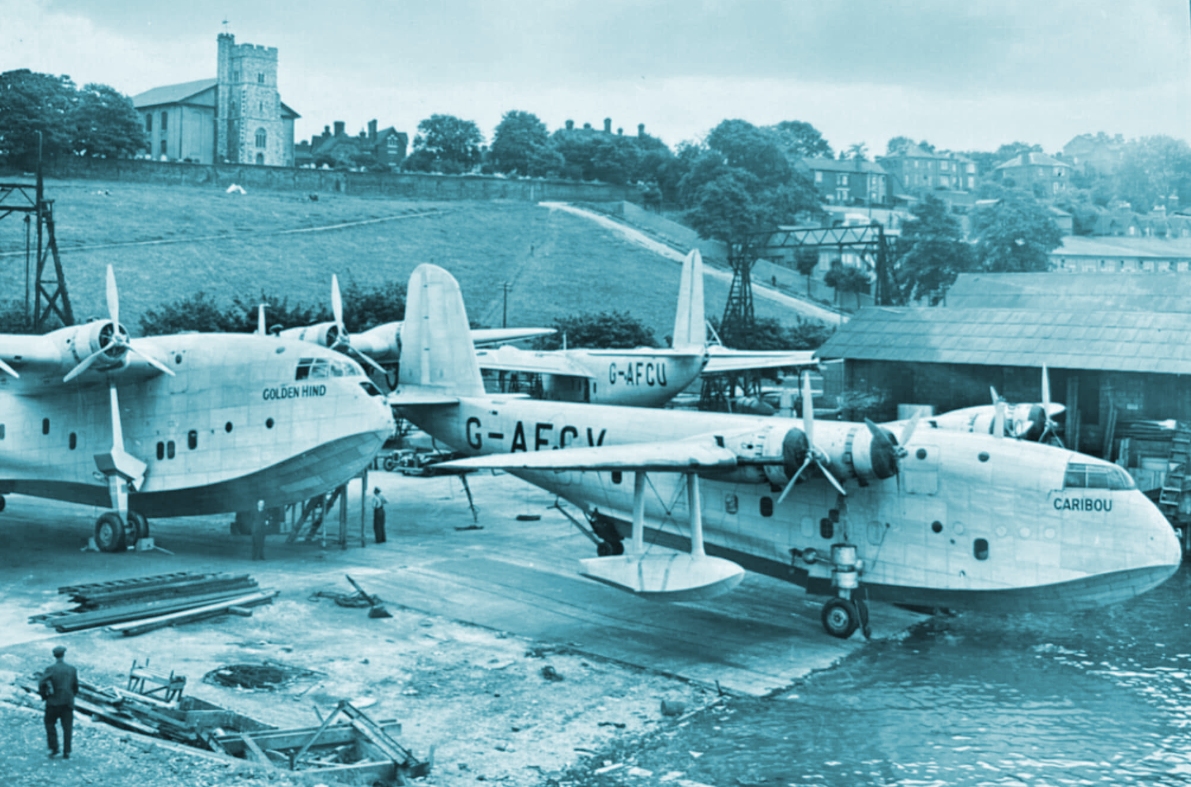
Flying boat types that maidened from the stretch of river to your right included the Sarafand, Empire, and Sunderland. Alan Cobham, the trailblazing aviator whose long-distance survey flights paved the way for Imperial Airways services to Africa, India and Australia, started many of his globe-girdling jaunts here.

God’s gift to composers of bawdy limericks, and home to U-475 Black Widow, a Soviet Navy, Foxtrot-class sub, Strood is where this Tally-Ho Corner Tour terminates.

I was tempted to do the remaining stretch of the add-on – Gravesend to Rainham – next week, but Roman thinks this would be “cruel” and “commercial suicide” and may have a point. Thanks for putting up with two weeks of dense Kentish trivia and for not putting your feet on the upholstery.

Thank you again. I am always astonished by your wealth of knowledge and/or historical resources, and of course entertained by the production.
Something I realize is that as an American, there is very little British history we are exposed to in our education or culture aside from Henry VIII, Robin Hood, our colonization and independence, and WWII.
Do you think you (or any commenter) might recommend a comprehensive-yet-digestible book and/or documentary series about the history of the British island and Empire? Extra points if it has an abundance of maps.
Apart from an old copy of Asa Briggs ‘A Social History of England’ (https://www.goodreads.com/en/book/show/609263.A_Social_History_of_England) which I’ve dipped into but never read from cover to cover, all of my books on British history are focused on specific subjects or periods.
I remember enjoying Simon Schama’s ‘A History of Britain’ series on TV. The documentaries and three companion books might well fit your bill: https://www.goodreads.com/series/119261-a-history-of-britain
Much appreciated!
Try the TV series ‘Cunk on Britain’ – episode 1 (and maybe others) is on Youtube.
I do remember Blue Bell hill always ‘being haunted’ when i was a kid, the female hitch-hiker who would get into people’s cars and disappear.