I hope you’ve got wide caterpillar tracks, Battle Drill. In coming months the weight of expectation pressing down on your mud-spattered hull is going to grow and grow. If you’re not careful, you’re going to find yourself buried up to your turret ring in some snow-mantled Hungarian hollow.
I’ve goshed and wowed over too many ultimately disappointing Combat Mission, Graviteam Tactics, and Close Combat wannabes over the years to completely lose my head over Battle Drill. However, watching the teaser videos and reading the words of the game’s solo developer, Karl, it’s impossible to qualify/quell all excitement.
Karl: “I’ve sunk countless hours into Combat Mission, Graviteam Tactics, Close Combat, Command Ops and Steel Panthers (and many more!), and I love them. But every one of them had a moment that pulled me out of the fight and broke my immersion. I’m also the kind of person who gets absorbed in the spectacle and history of what’s happening onscreen, and I’ve always wanted a game that blends the best of my favorite titles and also lets me just sit back and watch the battle play out. I never felt existing titles had AI competent enough, or a simulation deep enough, to depict a battle in a convincing and historically accurate way. So I’m building the game I kept wishing for: a simulation first and a wargame second, where immersion and history come before everything else. This is Battle Drill.
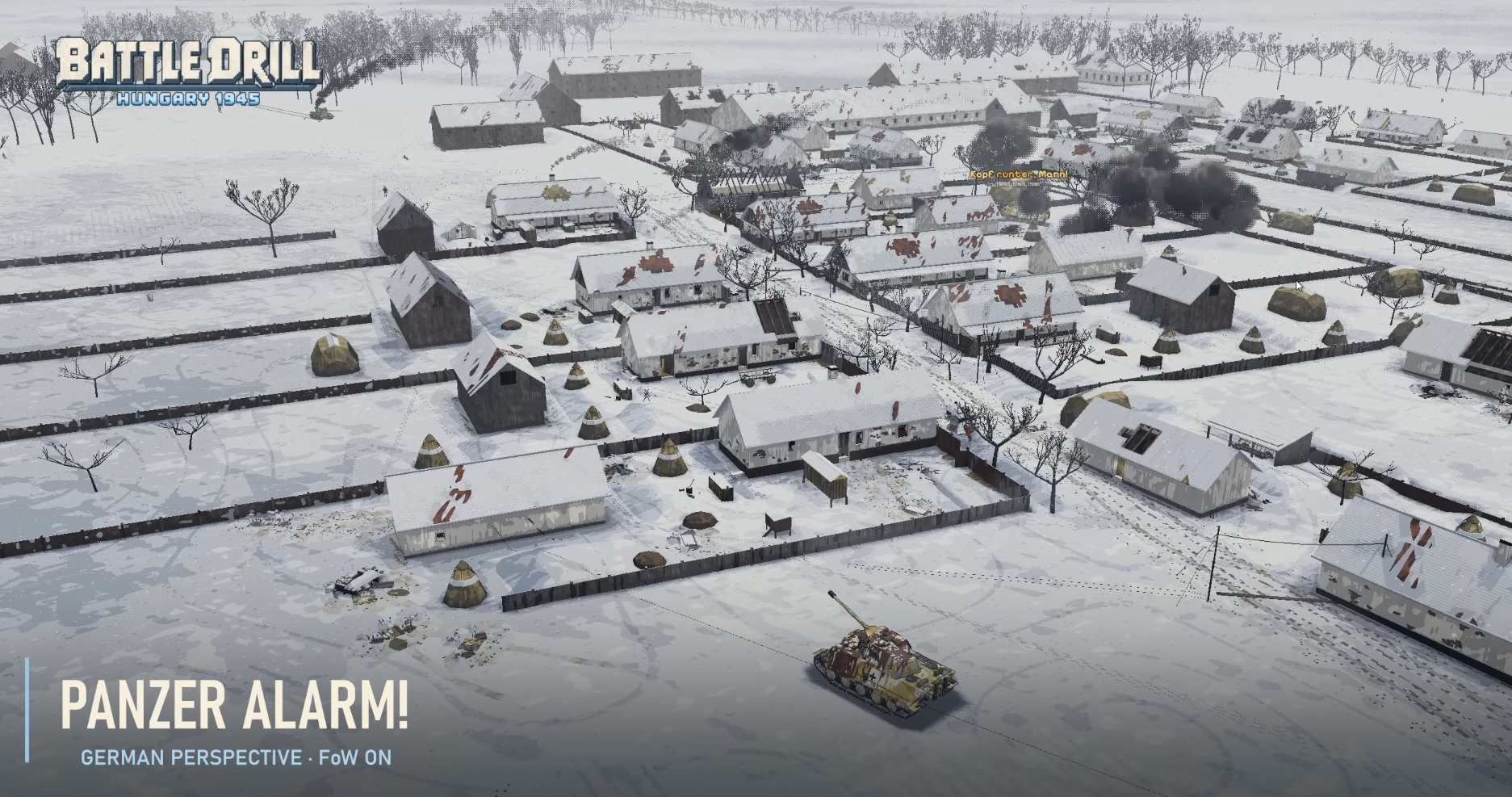
First battle: Pettend, Hungary, 27 January 1945.
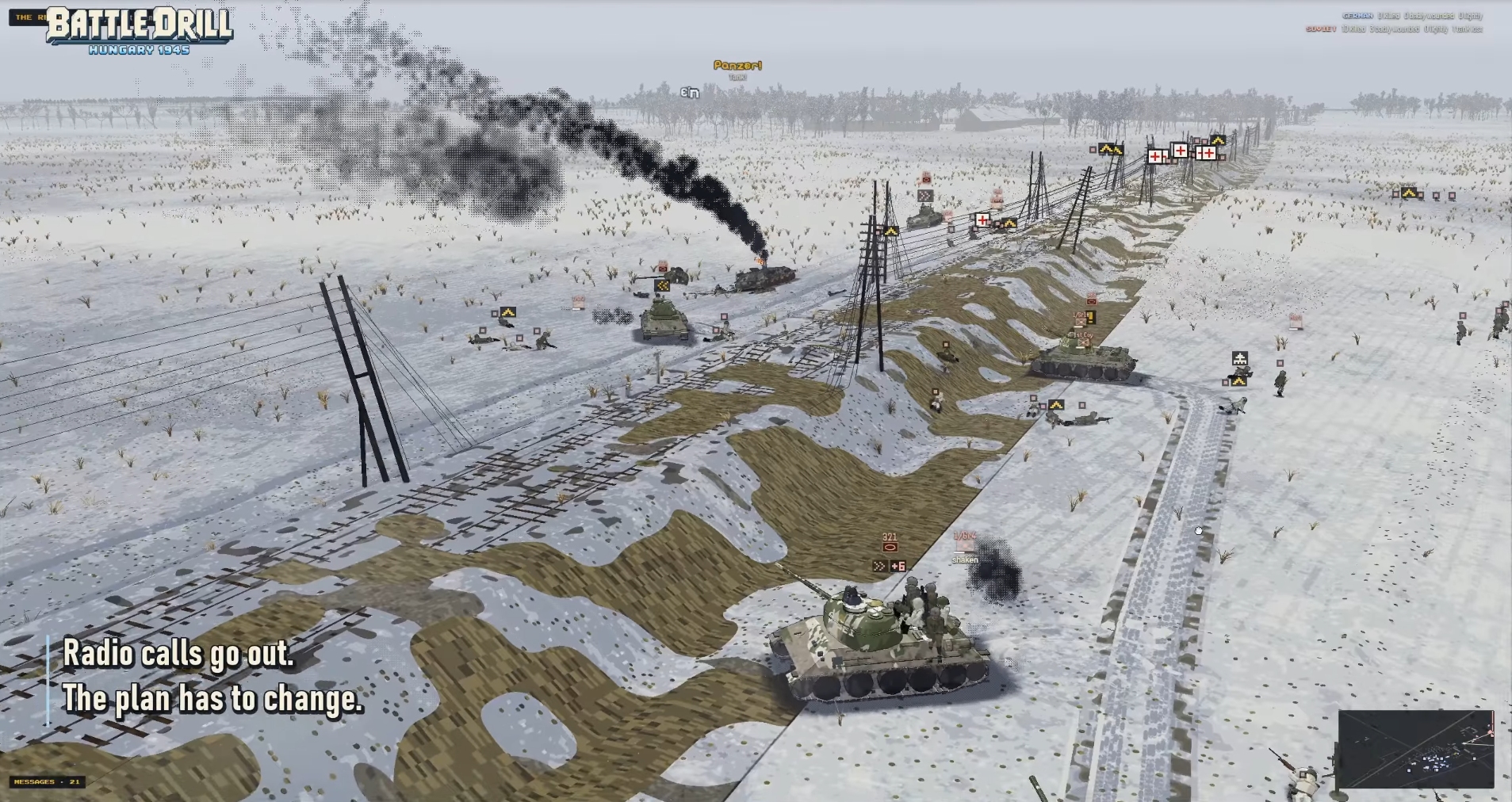
A Soviet tank-and-rifle assault on a village held by a German company and three Tiger IIs; a second wave attacking out of a snowstorm at 11:00; the German counter-attack in the afternoon.
Play a German platoon holding the houses, a Soviet rifle company riding the T-34s in, or a German company fighting to retake the village. Units, ground, weapons, weather and time follow the record, and where it falls silent I fill from researched historical doctrine and mark it as reconstruction. The outcome is never scripted.
If you don’t want to command, sit back and let the AI play out the battle. It was built to be a simulation first, and it’s proving to be incredible so far!
Under the hood, in numbers:
- Over 700 individually simulated soldiers and 50-plus vehicles on one field today, each with their own name, weapon, experience and orders. The aim is a full regiment a side, 5,000 to 10,000 men.
- 29 individually modeled hand weapons, from pistols and rifles to SMGs, MGs and Panzerfausts, plus 13 vehicle types (Tiger II, Panther, StuG III, T-34/76 and /85, SU-100, ISU-122, Sherman, T-60, Sd.Kfz 251 and more), each with its armor built plate by plate.
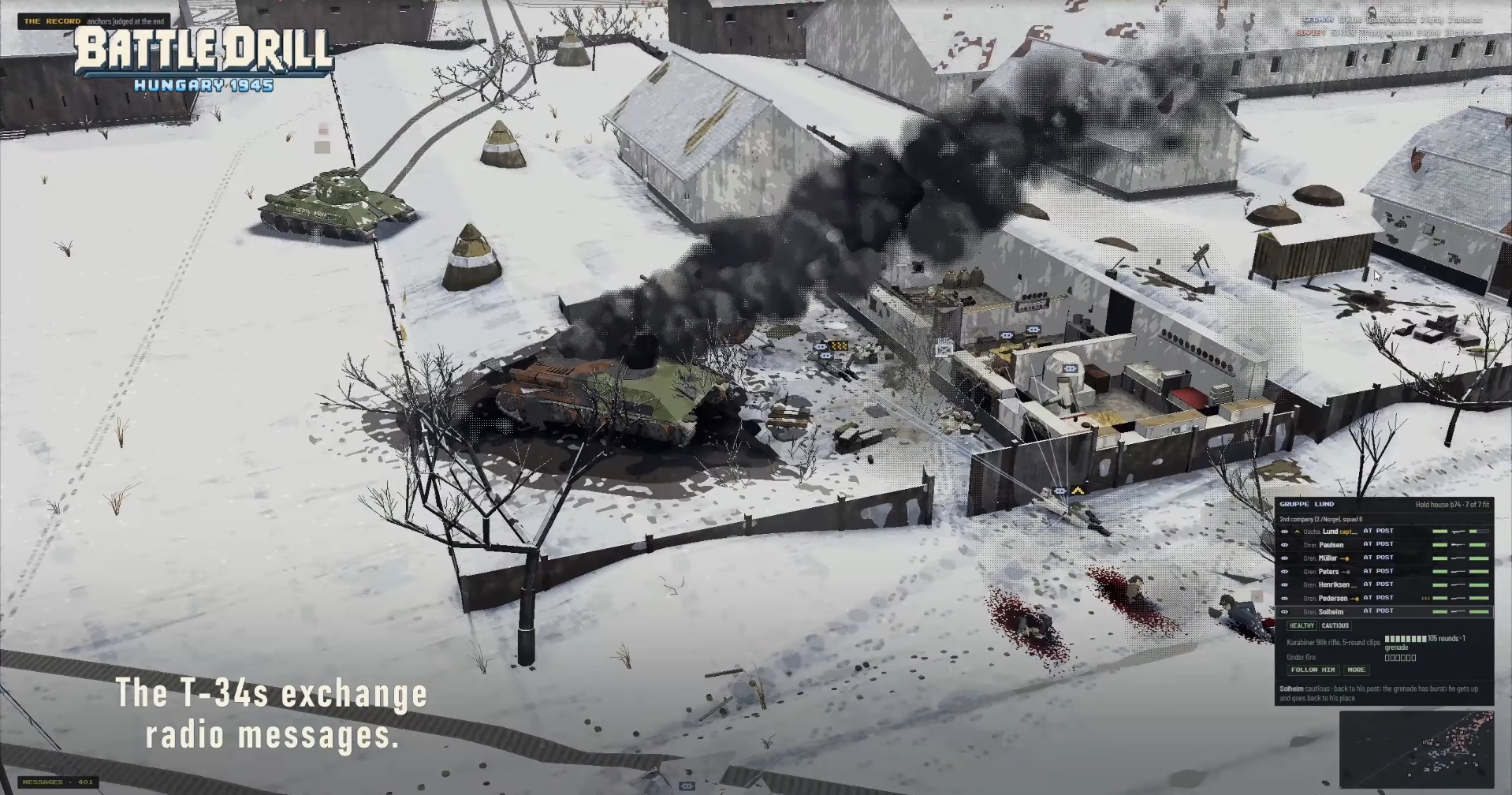
- Every round is a round: penetration against plate thickness and angle, ricochets, shatter, and what happens behind the plate to crew, fire and ammunition.
- A 2.9 × 1.9 km map of the Hungarian countryside around the village: 93 buildings, 1,134 trees, 24 roads, with walls that have real thickness for sight and rounds at every opening.
- Every battle is reproducible: the same seed and orders give the same fight, to the round. Great for sharing, comparing and studying. Pause, slow time and scrub back through the battle at any point.
- Head-to-head PvP: two players, each commanding a side, working today in testing. Online play for the packaged game is on the roadmap.
- A battlefield that remembers: the morning’s wrecks, craters and burnt houses are still there in the afternoon.
- Isometric pixel art that zooms from the sand table down to a single man; German and Russian voices with English subtitles; day, dusk, night and a snowstorm (more weather coming soon).
And the soldiers themselves: they take cover, dig hasty holes, wait for a lull before they dash across a doorway where a mate was just hit, carry the wounded, run short of ammunition and fetch more. Veterans don’t fight like new recruits. Medics work under fire and get wounded soldiers to aid stations.
It’s built by one person, with AI tools doing the typing and drawing under my direction. The engine is made from scratch. Kholm 1942, the besieged town and its garrison, is the next battle in the works, and I’ll be sharing the build as it grows.
The plan: a Steam page is coming, and when the game is ready there will be a free demo. I’ll share progress at every step. No dates yet, but I’d love to have you along for the journey.”
Quote: “Every battle is reproducible: the same seed and orders give the same fight, to the round. Great for sharing, comparing and studying.”
Is that good?
I can see a saved recording made at battle’s end having value for others to study, but this feels overly-deterministic. Yes, the same round fired at the same aimpoint should have the same impact, but it misses the human factors: the wait half a second for a better shot, etc.
On the other hand, as the author implies, maybe it’s a level of consistency some players do want so that they can measure their performance against others.
I hope it’s a setting that can be turned off.
Fully deterministic doesn’t mean human factors aren’t included. It means that the same soldier in the same situation at the same moment in time will always take the same amount of time to fire.
Another soldier will make a different decision.
A different order resulting in the tank being a metre away results in a different outcome.
Think of it this way: full, complete and total rewind through the whole battle. Where did you lose it. Rewind or replay to a specific point in time and try to do better.
That’s what you gain. What you lose is.. well, I’m not sure you lose anything. If you want a different battle you could just issue different orders?
I’m not convinced. It sounds like Soldier A with 75% to hit shoots first but gets 99 and misses. Even changing his path so he has a 90% chance won’t help because it was ordained before the game got underway that he’d get that 99.
Imagine a game played with dice. This deterministic version uses the gameseed to tell you the sequence for 50 rolls, at which point the sequence repeats. Apart from the narrow case of multiple players being able to complete the _exact_ same scenario, how is that better than rolling a die each time it’s required? It might even be worse: You shot first? Too bad, all your rolls are 1s. You shot second? What foresight; all your rolls are 6s.
There can’t be any more randomness than the 20 (or however many) digits in the gameseed. Got 13 in the range 0-4, and 7 in the range 5-9? Well, you can expect a lot of missed shots, fumbled reloads, and AP rounds that don’t penetrate.
To clarify, because you shot first you get the output from the oddly numbered positions in the sequence.