
The Crimson Banner: War of Liberation demo is quite something. Deftly translated, lavishly tooltipped, and unusually generous (including tutorials it boasts fifteen scenarios), it does exactly what trials are supposed to do: illuminate, entertain, and pique interest.
The game’s rich, refined mechanics have a lot in common with the rich, refined mechanics of a certain 2019 smash hit by 2×2 Games.

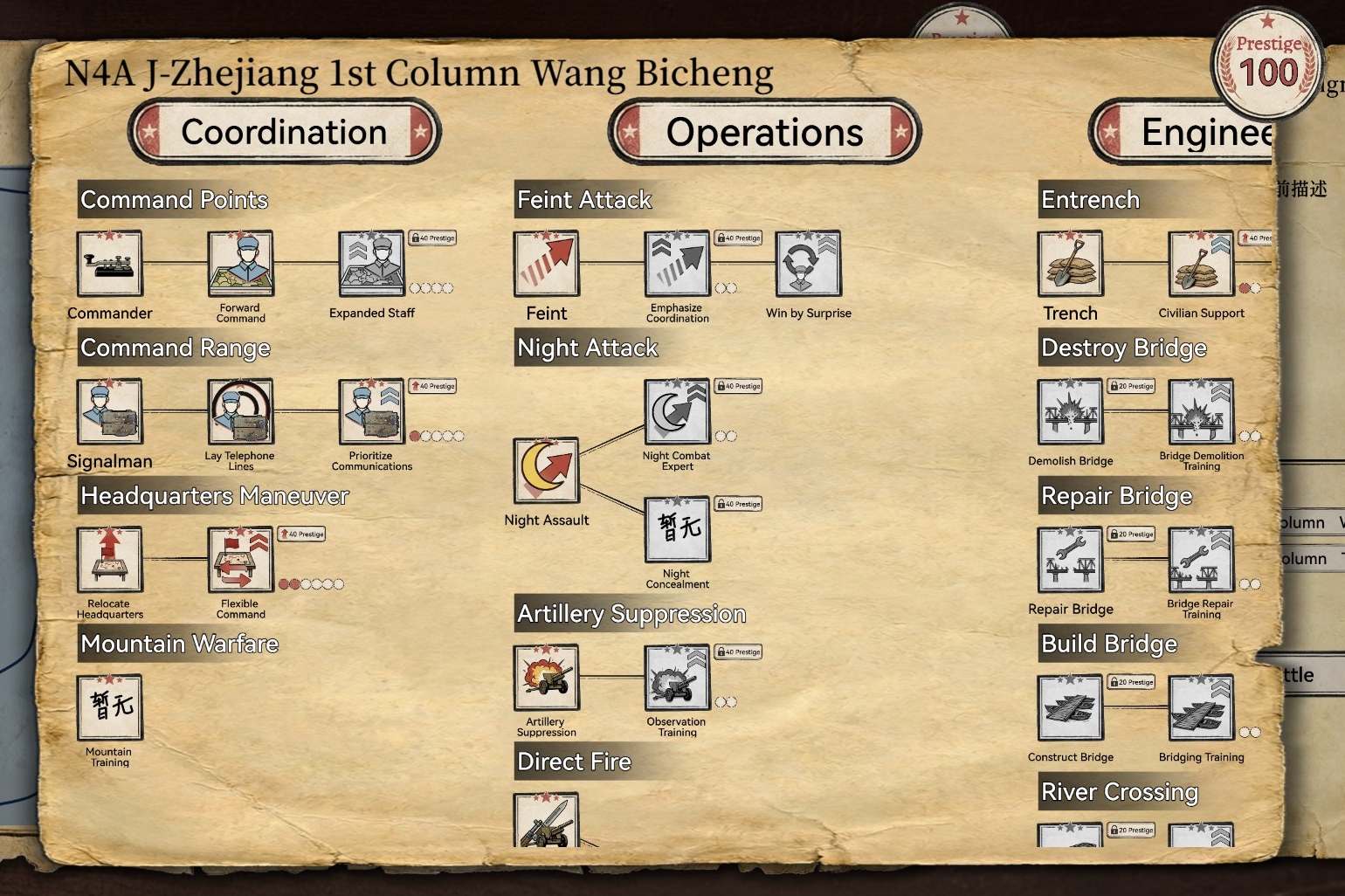
Supply networks can be shaped by placing depots, and are crucial to battlefield success. Assuming they are within range of their HQ, and that HQ has Command Points remaining, units can perform special actions such as feints, night attacks, ambushes, and infiltrations.

If it wasn’t for the strikingly original theme – the post-WW2 phase of the Chinese Civil War – the indebtedness might be distracting. Maps studded with unfamiliar towns, and armies devoid of armour and air cover, help keep awkward questions such as ‘When does a homage become a knock-off?’ at bay.

According to developer 赤旗制作组, the enemy in Crimson Banner (always Chiang Kai-shek’s Nationalists) is… “a master of military doctrine. It will use the fog of war to set ambushes, exploit weak supply lines to drive deep into your territory, and concentrate forces to breach your dispersed defenses.”. During the three hours I’ve spent with the trial thus far, I’ve witnessed no behaviours that cast doubt on this claim, but I can’t say I’ve seen any truly inspired manoeuvres either. Quiet competence from the Kuomintang has been the order of the day.

Like its Croatian touchstone, Crimson Banner believes in tight scenario time limits and binary victory conditions. If those characteristics prevented you from bonding with UoC2, it’s possible the same thing might happen here. However, anyone fond of 2×2’s work and/or hungry for hexiana with novel subject matter, is sure to be captivated by this demo-cum-prologue.

“tight scenario time limits and binary victory conditions.”
To me these will only ever be puzzle games, not wargames.